


Summary:
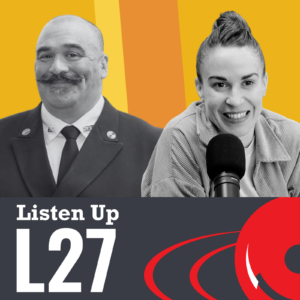
In this episode of Listen Up L27, host Jen Pennington sits down with Station 2 Clinic physician Dr. Ariel Erlich and retired Seattle fire fighter Terry Taylor to discuss the hidden health risks fire fighters face from microplastics, PFAS, and other toxic exposures. The conversation explores how modern fires release harmful chemicals, why decontamination practices are critical both on and off the fireground, and the everyday steps fire fighters can take to reduce cumulative exposure at work and at home. From on-scene decon procedures to reducing plastics in daily life, this episode offers practical guidance on protecting long-term health while caring for fellow crew members and families.
Takeaways
1. Decontamination Is About Cumulative Exposure
No single fire, chemical, or incident defines your long-term health risk. The goal of decon is to reduce the cumulative exposure that builds over an entire career—and every exposure you avoid matters.
2. The Decon Mindset Shouldn’t Stop at the Station
Fire fighters have become disciplined about managing contaminants on the fireground. The next step is applying that same awareness to everyday choices involving food storage, cookware, water bottles, and household products.
3. Compliance Matters More Than Policy
Departments can establish best practices, but they only work when they’re consistently followed. Gross decon, gear handling, showering after exposure, and keeping contaminated equipment out of living spaces remain some of the most effective tools available.
4. Small Changes Add Up Over Time
Long-term health is shaped by thousands of decisions made throughout a career. Simple habits—whether on scene or at home—can help reduce unnecessary exposure and support overall health over the long haul.
5. Protecting Your Family Is Part of Protecting Yourself
Reducing exposure isn’t just about personal health. Good decontamination practices help prevent contaminants from reaching the station, your vehicle, and your home, protecting the people who matter most.
Resources:
- D1-On Scene Decontamination Guide
- National Institute of Health-Journal of Occupational Medicine On Scene Decon
- “The Plastic Detox” on Netflix – The film follows six couples with unexplained infertility as they attempt a 90-day challenge to eliminate plastic and its associated chemicals from their daily lives. Guided by environmental epidemiologist Dr. Shanna Swan, the participants swap out plastic food containers, personal care products, and household items to see if reducing exposure to toxic additives (like phthalates and BPA) improves reproductive health.
Trailer
Transcript
[00:00:02] Dr. Ariel Erlich: It’s sometimes challenging to take a group of people who are risking their lives frequently and interest them in things you can’t see, which may increase your risk far down the road.
[00:00:16] Jen Pennington: Hey, Seattle fire fighters, you’re listening to Listen Up L27. I’m really excited to tackle a subject today that we don’t get to talk about too much here. So when you respond to a fire, you expect heat and smoke and chaos, but that’s part of the job. So what we’re going to be talking about today is what’s harder to see, what’s harder to shake, everything that comes with it. So you might have burning plastics or synthetic materials, furniture, electronics, all of it breaking down into microscopic particles and chemicals that don’t just disappear when the fire’s out.
So today I am joined by Dr. Ariel Ehrlich from Station 2 Clinic and Terry Taylor, who is a retired Seattle fire fighter and he was also a nurse in a former life as well. Terry, when you think about a modern fire scene today, what, what can fire fighters be exposed to?
[00:01:17] Terry Taylor: Right.
To talk about today is, is a little difficult for me because I retired in 09, but I can tell you, when I first started working, I actually worked with my future father in law and found out from my subsequently over the years that she remembers when he, Jack Rutherford, when he came home from work, he brought his protective clothing with him to clean and the whole house would smell like a fire for several days after they washed and dried it. So we’ve come a long way in protecting ourselves and taking the steps that are necessary. But at the same time, we still need to continue our efforts and do more.
In a typical fire, when you go in, there’s smoke, any kind of smoke. You’re going to put on your mask and be on air. You’re going to protect yourself from an atmosphere that is unknown to you. If you can see smoke, that’s maybe something. But when things are burning, gases are being produced and chemicals and you want to protect yourself from that. So you mask up before you enter the so called hot zone, where the fire is or where we suspect the fire is. A typical fire during my career would have been a kitchen fire where there’s light smoke coming from the house and we enter typically through the front door and kitchens oftentimes are towards the back of the house. So as you go back towards the back of the house, you get a sense of how involved it is because of the level of smoke or the level of heat. But as you enter the front door and you know that you have a kitchen fire, you’re going to have your mask on, you’re going to be covered and that’s to protect you. And as you advance then you discover what’s actually going on. And we still need to wear the self contained breathing apparatus.
We don’t want to expose ourselves to even that smoke because we don’t know what’s in that smoke.
It’s called an atmosphere that’s immediately dangerous to life and health, IDLH. So that would be a typical situation in the past. In the beginning of my career, there wasn’t, after a small fire like that with light smoke, there wasn’t any decontamination.
We just went back to the firehouse and hung up our stuff and that was it and we waited for the next call.
Nowadays where we take more precautions and nowadays there are specific steps that we take. Even if there isn’t smoke, if there’s something burning and there’s a, we’re searching for the origin of the fire before you go into that atmosphere, you cover and then you have to decontaminate as you come out.
[00:04:04] Jen Pennington: And I think one of the things that you’re not seeing obviously is like a lot of the microplastics that can be burning around you and you might have some chemical absorption happening. And we’re talking about things that are cumulative. What I’d like to ask Dr. Ehrlich, when you hear terms like microplastics and plasticizers and PFAS and all these things, can you break down what these are? Certainly.
And in plain terms, absolutely.
[00:04:37] Dr. Ariel Erlich: So when we think of microplastics, literally it’s a bit of plastic that’s 5 millimeters or less and those generally come from larger plastics, car tires, clothing, single use food items, wrappers and stuff like that, and then plasticizers, bisphenols. These are a huge number of chemicals that are often found in plastic that have similarly, they have awful effects on the human body. And then PFAs are an even bigger group of forever chemicals which include not only items that are found in plastic, but also anything. Well, most items that are stain resistant or used in manufacturing to make something resistant to water or grease or heat, which includes of course, a lot of the equipment that fire fighters use.
And all of these to some degree can cause issues with, they can cause reproductive problems, many of them can cause cancer, many of them can cause heart disease, high cholesterol, diabetes and even developmental problems in young children.
[00:05:49] Jen Pennington: And how are they getting into the body?
[00:05:52] Dr. Ariel Erlich: Well, formerly, when these started being used many decades ago, it Was in, say if you had a Teflon pan or you had heating something in plastic, anything that plastic touch that you then consume can get into the human body. But now that plastics are now in the environment, now that they’re breaking down and getting into water supply, now that sewage sludge with microplastics and these forever chemicals are being used to irrigate your farming fields. They’re now everywhere. Food, water, air, it’s very hard to avoid exposure to these. But there’s still a lot that people can do to limit their exposure, especially people with a greater risk of these health issues than the general population, which of course would be fire fighters.
[00:06:44] Terry Taylor: One of the things that I read as I was looking at this subject yesterday was a recent study in California identified PFAS chemicals mixed with the pesticides and they found it on strawberries.
So now they’re finding these microplastics combined with pesticides that are used at a permissible limit on fresh vegetables. And these are the snacks that we’re giving to our children.
So we’re becoming more and more aware of the issue with microplastics and our exposure to them that we don’t know or understand about yet.
[00:07:23] Jen Pennington: Yeah. And I mean, I’m also curious, in the decon phase, a lot of times you’re on a scene, you see fire fighters, they’ll be scrubbing down with like soap and water before it even gets back to the station. Is that correct?
[00:07:37] Terry Taylor: That. Oh, yes, that’s what you’re supposed to do. You’re not supposed to bring it back to the station and certainly keep it out of the living quarters at the fire station. Yes.
[00:07:46] Jen Pennington: So, I mean, there are some things that we can do to limit the exposure after a firefighter goes into a scene.
[00:07:56] Dr. Ariel Erlich: Oh, absolutely. I think Terry focuses more on health issues. So these chemicals, when fire fighters are on the job, I do more when they’re off work.
Because certainly you don’t want to be exposed to all these chemicals at work and then you come home and these chemicals are everywhere there as well.
[00:08:16] Terry Taylor: Yeah, it’s almost like we’re doing the same thing but with a different emphasis.
We’re both concerned about the cumulative exposure and the lifetime risk that the exposure poses.
But I’m concentrating more on the on scene, event oriented exposure and how do we deal with that. And she’s concentrating, concentrating on what follows and how things play out over a lifetime or a career.
[00:08:45] Jen Pennington: And I think we often think of, like what we call decon as happening in the station to the gear.
But what we don’t address is what’s happening in the station or even in your homes where microplastics can be like, it might be in a Teflon pan, it might be part of plastic utensils that you’re using to cook with and things like that. So I’d like to talk a little bit about, you know, how. How we can minimize even the contamination risks that are happening in the environments where we don’t think we’re being contaminated. You know, we think, oh, we, we’re back from the fire. We’re good, you know.
You want to take that.
[00:09:40] Dr. Ariel Erlich: A lot of these toxic exposures, we think about these enormous and dramatic fires which people are exposed to. But the plastic container that you’re heating your lunch in, the microwave is also risk. And you’re being exposed to that much more often for some people.
And one of these is much easier to limit your risk to.
So a lot of what we do is focus on, well, could you bring a glass container, maybe an aluminum can instead of a plastic water bottle, bring a reusable water bottle. These are all things that matter and they’re relatively easy to do.
[00:10:20] Jen Pennington: Yeah. And I mean, what does the cooking situation look like in a kitchen in the beanery for you?
Do you recognize some of the materials that you’re like, oh, yeah, we shouldn’t be using that or something.
[00:10:34] Terry Taylor: The individuals decide that for themselves.
I think there’s a learning curve there. And when we become more educated about what we’re being exposed to with what we bring from home to work and things like that, then we’ll be more conscious of that. I’d like to circle back though, to decon.
And of course, we go through an on scene gross decontamination where there’s an initial rinse with water, and if you don’t have particulates, you just get hosed off. But if you have particulates and. Or you’re exposed to smoke or there’s an unknown contaminant, it then you get soap with the brush and you get hose off that way and you remain on air. You keep your mask mounted, regulator on so that you don’t breathe the air while you’re being decontaminated. You remain masked up.
When you get back to the station, what’s important is to make a transition. You place all your protective clothing in a bag, and that goes in a compartment, not in the. Where you’re riding in the crew cabin.
So you isolate your protective clothing that you had decontaminated on scene in a bag, bring it back to the station. And then you continue both personal decontamination and decontamination of the protective clothing. You shower within the hour. You use special soap. The safety chiefs are now handing out special soap to use after a gross decontamination.
And also on the scene, after you take your clothes off, you’re wiping yourself off with wipes and clean your skin where there might have been any exposed areas. And that’s important to decrease the amount that you bring back to the station. When you get back to the station, then you’re doing what’s called the secondary decon, the specialized washing. The protective clothing gets washed in a special washing machine called an extractor. And that clothing and any articles that you were exposed to the fire scene are prohibited from being in the sleeping, food preparation, or living areas of the fire station. And that’s a rule that needs to be reinforced and followed. You know, compliance is part of the protection.
And the more we can get the fire fighters to individually comply with all the steps, the gross decontamination, the secondary decontamination, and then cleaning their equipment, the better off they’ll be in the long run and will contribute to less cumulative exposure.
[00:13:04] Jen Pennington: Yeah.
Would you like to add to that?
[00:13:07] Dr. Ariel Erlich: Oh, yes, it definitely all adds up. For certain, it’s sometimes challenging to take a group of people who are risking their lives frequently and interest them in things you can’t see, which may increase your risk far down the road.
But, yeah, because people are at greater risk, it makes this all the more important.
[00:13:29] Jen Pennington: I think what we’re talking about is. I mean, Terry, you did a really great explanation of the steps that you’re doing through decon, trying to limit your exposures. And I think what we’re also trying to do is we’re trying to transition to how we can minimize other areas of our lives with this taking in microplastics and things like that that we don’t know that are part of our food. And food is a big thing because you guys buy your own food and bring it back to the station.
[00:14:01] Dr. Ariel Erlich: To some degree, the food safety in terms of chemicals are e. Even in terms of the health quality of the food itself is a group effort.
And sometimes, even if you can’t necessarily interest a particular firefighter in their own health, they’re more likely to be interested if they’re protecting someone else, you know, their team member, or, you know, going home and making sure, you know, they’re not bringing any contaminants home to their family.
That can be a lot more compelling.
[00:14:31] Jen Pennington: I mean, did you probably. When you were in service, you might not have thought about some of the things that you were also being affected by just in your general environment.
[00:14:41] Terry Taylor: Well, correct. We hadn’t discovered the evils of microplastics yet when I retired in 09, but we did improve in terms of gross decontamination and decontamination gestation and taking some of the steps which are now absolutely recommended to prevent cumulative exposure. So we, you know, we’re moving along.
I think this is a wonderful area to expand where we have more of a consciousness or an awareness of how our diets, our environment, also contribute to our cumulative exposure.
[00:15:19] Jen Pennington: Yeah, I think it’s an important discussion. And something I recently saw was the documentary called the Plastic Detox.
[00:15:30] Terry Taylor: Yes.
[00:15:31] Jen Pennington: And did you see that?
[00:15:32] Dr. Ariel Erlich: I did not know.
[00:15:33] Jen Pennington: Oh, this is right up. It was good, wasn’t it?
[00:15:35] Terry Taylor: Yes.
Seen several. Thank you for alerting me to that. I’ve seen several others that basically underlined that. There was one that had a chemist who was a renowned chemist and had many patents and was very successful. And he had a change of heart and he didn’t understand that the industry did not consider the downstream effects of the chemicals they were creating.
And so he decided that that was going to be something he was going to focus on. And he’s trying to get and making efforts to get that subject matter into curriculums for chemistry students.
So moving forward, there will be more of an awareness for the general population about what the risks are of the chemicals that are in our environment than what we’re exposed to.
[00:16:25] Jen Pennington: Yeah, he was fascinating.
He was talking about how you’re taught chemistry, but you’re not taught about the toxicity of what you’re making. But I thought what was also interesting about this, and you will find this very interesting, they also followed a doctor, I’m going to get her name wrong, but she’s well respected in her industry. And she was working with six couples who were having trouble getting pregnant.
[00:17:00] Terry Taylor: Correct.
[00:17:01] Jen Pennington: And what was fascinating was she was studying the phthalates in the phthalates in the levels in the body. It was. It was fascinating. And what was it? The bisphenol A.
You know, they’re all their levels. And so they took these six couples and they made sure that they changed things about the kitchen, things about their personal hygiene, getting rid of all the microplastics that they could possibly do. And then they measured the data after 90 days, and it was fascinating. And here were these couples that were having trouble getting pregnant. And three of the couples actually got pregnant and, you know, they had Tried in vitro and everything else. And so it allowed her to have enough data to take it through to a larger study. And I think that’s where she is now. But it was. You know, they talked about all the things that you just talked about, where it’s in. It’s in your clothing, it’s in the synthetics, it’s in the utensils that you use to cook with every day. It’s all those things. So if you can.
Yeah, if you can watch it, it was right up your alley.
[00:18:23] Dr. Ariel Erlich: That sounds great.
It’s interesting that a lot of the problems with the microplastics and the fibrochemicals could best be managed on a national or international level, regulating against these chemicals, like a lot of what California has already done.
And I feel like one of the major reasons it’s not happening is allegedly because of politics. For example, right now, the EPA has just been gutted.
And science, science, civic studies on these issues have been gutted. And the petroleum industry is really pushing towards public opinion, trying to make plastic seem like a friendly and harmless thing.
But it seems like a situation where clearly the vast majority of humans of any political bent are united in wanting not to have low sperm count or cancer or their children have developmental problems.
So, yeah, ultimately, I think if we could all come together on that, we could really do some good.
[00:19:30] Jen Pennington: Oh, absolutely. I mean, after watching it, we started looking in our kitchen. It’s like, that’s going. That’s going.
Getting tossed and, you know, slowly. And it’s incremental.
It’s small steps to get there. It’s not like, take your whole house and, you know, toss these items and whatnot. But, you know, but some of these things, you know, you train your whole life as a firefighter for the things you can see, the flames, the, you know, the structure, the risk. But I think that there’s not a lot of talk about what you carry after.
After the call.
Any thoughts on that?
[00:20:17] Terry Taylor: Sure.
[00:20:17] Dr. Ariel Erlich: I think some of the more successful marketing about microplastics has been in the infamous study that announced that people have the equivalent of a plastic spoon in their brain. And that suddenly became something that people could visualize and see. And it became vital in a way that, oh, these chemicals that you can’t see maybe sometime will cause terrible problems for you. And we probably need more things like that to illustrate the urgency of these problems.
[00:20:50] Terry Taylor: Yeah, well, of course, I’m going to circle back to the grove’s decontamination and the steps that are being taken in the field and they need for emphasis. There was a study, not recent, but In November of 2023, there was a study titled Evaluating Firefighter on Scene Decontamination Practices Using the National Fire Records Management System.
And this was the first study of its kind. And they had a cohort of 2,500 fire fighters throughout the United States. And the results suggest that too few fire personnel are performing decontamination on scene following exposure.
So my point of emphasis will always be to encourage compliance with what’s best safe practices. Even if you don’t see the smoke and you know that there’s been combustion and you can’t identify what the atmosphere is, you’re supposed to treat it as an atmosphere that’s immediately dangerous to life and health and follow the decontamination procedures. And that’s the best way to protect yourself, your fellow fire fighters and your family. And you hopefully will decrease your career cumulative exposure.
[00:22:13] Jen Pennington: Any last thoughts as we close out today about this subject?
[00:22:20] Terry Taylor: Well, I would refer the working fire fighters to refer to the Washington administrative code 296305, which covers fire fighters and stay up to date with the decontamination procedures that are recommended by your department and follow them and it will help you with your quality of life going forward and protect your loved ones also. So keep them safe from you bringing this home.
[00:22:51] Dr. Ariel Erlich: Thank you, Terri. If there’s one thing the fire department does wonderfully and hopefully the Station 2 clinic attached to it is taking care of people. And I’ve really enjoyed seeing the way that Station 2 is adapting to all this information about microplastics. By changing the snacks that are available, people are encouraging each other to bring in reusable water bottles. Things like, I think that’s one of the places where we’re strongest, that we can do things to help other people that we might not necessarily do for ourselves.
[00:23:29] Jen Pennington: Well, I want to thank you both for being here. This has been a really great conversation. I’d love to do another one like this in the future on this. It’s a great subject. It’s a really great subject. Thank you, Terry, for all your knowledge. And you can also see Terry’s tips on some of our articles. He’s our safety consultant, it seems like these days.
And we just appreciate both of you being here today. Thank you so much.
[00:23:54] Dr. Ariel Erlich: Thank you so much.
[00:23:55] Terry Taylor: You’re welcome. Thank you for having us.
[00:23:58] Jen Pennington: Thanks for joining us. Listen up. L27 is a Seattle firefighter Healthcare trust production. This podcast is produced by the Rhizome Collaborative. I’m your host, Jen Pennington. And until next time, stay safe and stay healthy.