
Moral Injury in the Fire Service
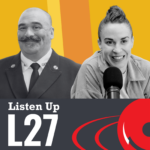
Every fire fighter carries stories from calls that didn’t go as hoped. Most of the time, those memories fade. But sometimes an experience lodges in your memory and won’t let go, not because of what it did to your body, but because of what it did to your sense of who you are. That’s what Station 2 Clinic Mental Health Therapist Jamie Epting and Lt. Bill Hartung, Lead Peer Support Coordinator for the Seattle Fire Department, unpacked in a recent episode of Listen Up L27: Moral Injury in the Fire Service.
Moral injury is a complicated concept, but Jamie Epting defines it simply: moral injury occurs “when an experience goes against your core values, and it stays with you because it challenges how you see yourself, others, and the world.” Bill Hartung adds some texture to Jamie’s definition:
It can be a situation where something happened that you couldn’t control, and you feel bad about it later, wishing you could have done more, wishing the outcome could have been different. It could be something that you see that’s unethical, whether that’s somebody that you work with or somebody that you work for. It could be political in nature. It could be policy-based. There can be many different things that go against who you are and what you stand for and what you fully believe in.
Moral injury may also be intertwined with PTSD. Although a moral injury may not directly threaten your physical survival, your body may interpret the stress of a moral injury as a threat—and vice versa. PTSD may lead to a deep sense of moral injury.
Fire fighters are especially exposed to moral injury because, as Epting puts it, they work in a world where morals and judgment are part of the code. Almost every call carries moral complexity, which means more processing and more replaying of events afterward—especially when something sticks or doesn’t resolve as it should. Hartung describes the pattern from the inside: fire fighters constantly analyze their performance, and when a call doesn’t go as expected, they rehash it, sometimes lying awake at 3 a.m., running through what they could have done differently.
Part of what makes this so specific to the job is the professionalism fire fighters are trained to snap into. Hartung describes pulling up to a familiar address, thinking “here we go again,” and then the switch flips the moment he steps off the rig. Everything drops away except the job in front of him. The emotional weight comes later, on the drive back to the station, or when nobody on the crew brings it up at all. That silence, Hartung says, is often the real problem: everyone wondering whether the others feel the same way, and nobody wanting to be the one who says something first.
There’s also a systemic layer. Epting calls it betrayal trauma, when the system a fire fighter serves doesn’t show up for them the way they show up for everyone else. Fire fighters are problem solvers by nature, but much of what they’d like to fix sits behind policy, procedure, or decisions well above their pay grade. Watching the same person cycle through the same address, having poured in real effort with no lasting change, adds up over time.
It’s worth understanding how moral injury differs from PTSD, since the two are often lumped together. Epting explains that PTSD is rooted in a threat to survival: your body reacts as if your life is in danger, even when it isn’t. Moral injury doesn’t threaten your life—it threatens your sense of self and your sense of how the world should work. The two aren’t mutually exclusive. You can have one without the other, or both.
So what actually helps?
Both Epting and Hartung return to the same starting point: talk about it. That might mean the peer support team, the union, the Station 2 Clinic, or even a lieutenant or captain who’s earned your trust. Hartung is clear that it doesn’t matter who, only that it happens. Epting adds a practical filter: separate what’s in your control from what isn’t, and be mindful that unchecked venting can deepen negativity rather than relieve it. Leadership plays a real role, too. When officers name what happened out loud (“that was a rough one; let’s talk about it”), it gives everyone else permission to do the same.
Maybe the simplest takeaway is the one they both land on at the end. You’re not alone, and it’s okay to feel upset, betrayed, or haunted by a call you wish had turned out differently. It’s a normal part of the job, not a sign that something’s wrong with you.
There’s much more nuance on this important topic in the full podcast conversation, including how peer support works day-to-day and how leadership can better recognize moral injury when it shows up. Give the episode a listen.