


Summary
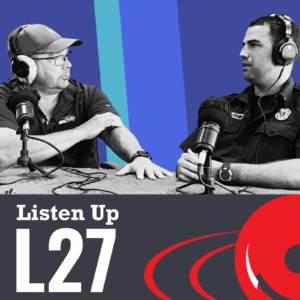
Jen Pennington sits down with Station 2 Clinic Lead Therapist Laura Takacs and Captain Matt Lujan to discuss one of the most difficult responsibilities a fire fighter can face: telling a family their loved one has died.
It’s about what these moments feel like on the scene and how fire fighters can approach families with compassion and clarity. Simply being present can matter more than trying to “fix” the situation. The conversation also dives into the emotional toll these calls can take over time, how trauma can build quietly beneath the surface, and why mental health support and crew connection are critical in the fire service.
Honest insight, practical guidance, and a deeply human conversation about grief, resilience, and the unseen weight many fire fighters carry throughout their careers.
Transcript
Listen Up L27 Podcast Transcript
Opener:
Matt Lujan: This may have felt like a routine call, one of tens of thousands of calls will go on in our career.
For the family, this is one of one.
They’re likely never going to have anything like this happen again.
So for us, we may by the next shift not remember the details, some of the details of the call. The people that we’re serving and helping in that moment, they’re going to remember.
Introduction:
Jen Pennington: Hey, Seattle fire fighters, welcome back to Listen Up L27. Today’s episode covers one of the hardest parts of the job, that moment when you have to tell someone that their loved one has died.
It might be at a fire scene, a medical call or a car accident. And in that moment, everything changes for them and for you.
We’re joined today by Laura Takacs, lead therapist from Station 2 Clinic, and Captain Matt Lujan to talk about what that experience looks like, how to handle it and how to take care of yourself afterwards. Well, welcome both of you. Thank you for coming.
Laura Takacs: It’s great to be here.
Matt Lujan: Thanks for having us.
Laura Takacs: Yeah.
Jen Pennington: And Matt, let me ask you something. Can you walk us through what it might look like in that moment?
What does it feel like when you realize you’re the one that’s going to have to say something to a family or loved one?
Matt Lujan: Yeah. I mean, for us it kind of happens in two different ways. One, we might be going to the scene to confirm that someone has passed away where the family suspecting that like they know their loved ones in hospice or whatever. And then the other is a medical event has happened. We show up, we do our job, we perform whatever life-saving efforts we’re going to do. And then the outcome isn’t what we want or what the family wants. And we have to share that information.
And it is a very real and heavy and sobering experience that you’re going to share with somebody some information and news that’s going to change their life forever in an instant.
So it can be very, very challenging and weigh heavy on people as they have to think about what they’re going to say and how they’re going to share that information with the family.
Jen Pennington: And Laura, from your perspective, what’s happening for both the family and the fire fighter in that exact moment?
Laura Takacs: There’s a lot going on emotionally. The family could be feeling shock, horror, disbelief, anger, which can be a lot of the same feelings, experiences that the fire fighters themselves are feeling. In addition to that, the whole experience for the fire fighter could really resonate and hit home in a very hard way of their own losses.
And the wish or the Desire, the need to fix this that a fire fighter might be feeling, that can be a really difficult thing to not be able to be proactive about, because there is no fixing this.
Jen Pennington: Yeah, it’s like, you know, how do you even approach grieving in that moment when it hasn’t even really been fully realized for the person that it might be happening to?
Matt Lujan: Well, and I think that’s one of the challenges. Laura and I were talking earlier.
fire fighters, by nature are fixers. That is one of the reasons they got into that line of work, is to be a problem solver over and help people.
And now you’re faced with this, you’re in this environment and you’re in this situation where there may be nothing you can do. And it can be unsettling. It can make fire fighters feel uncomfortable because they want to do something, they want to be proactive, they want to help.
And really, maybe the only thing they can do is just be there and be sympathetic and be caring and empathetic, and not always an easy thing for fire fighters to do. So that can be challenging for them
Laura Takacs: to add on to that. The family might be demanding, in whatever way, fix this, do something to make it better.
And to your point, when there’s nothing to do, those types of demands or the emotion that’s coming out from the family member can feel very personal, and that can be something that the fire fighter walks away with.
That level of emotion and the inability, the helplessness to be able to really fix this.
Matt Lujan: Yeah, that does happen where families look at us as we’re sharing information that there’s nothing more we can do. There’s gotta be something else you can do, do more. And it’s not really directed at us. I think for them, it’s a sense of disbelief and trying to come to grips with what’s actually happening and wanting us to do more, even when there’s nothing else we can. So that’s hard for us, it’s hard for the family. It’s a challenging experience.
Jen Pennington: So with that said, what are some of the things that might be helpful in that moment? What’s helpful and what isn’t?
Laura Takacs: The simple things might be overlooked, and they might not feel simple in the moment. But having worked with families that have lost loved ones, one of the first things that comes to mind is to being able to say the person’s name. So having a fire fighter ask, tell me who your family member is. Who is your loved one?
This is Dave.
I’m sorry, but Dave has died. When a family member hears the curing and the Question asked by the fire fighter who their loved one’s name is. All of a sudden that person has a name and it’s more than just a scene. The family member can see that. The fire fighter sees that this is more than just another sc.
That this isn’t actually a human being.
Matt Lujan: Yeah, sorry to interrupt, but just by the nature of the incident, we’ll have the patient’s information like we do an ESL report. So it’s an electronic medical form and we’ll get their name. So we’ll have that ahead of time. But I think that’s a really great point because later I think we’re going to talk about some simple things that we can do. And that’s a really great idea and a very tangible thing that someone can do, whoever’s sharing that information is to use the patient’s name.
But the first time you have to do that, it’s a very strange feeling to look at someone who’s watching their loved one go through this and you’re saying, to your point, I’m sorry, but Dave has died and there’s nothing else that we can do for them. That’s a very almost out-of-body surreal experience for folks. But that’s a great, tangible thing that someone can do is actually use their name and humanize the experience that. That they’re going through.
Laura Takacs: And would you say, Matt, that.
That it’s difficult or maybe it’s easy for fire fighters to be gentle but direct at the same time.
So not using terms like we’ve lost Dave or Dave has passed, where the family might have to kind of decode or understand, figure out what has actually happened.
Matt Lujan: Yeah, I think it’s somewhat personality dependent, but we’re probably better at being direct than we are at.
At being gentle.
But I’m just speaking mostly to my own experience and viewing things through my lens.
But yeah, I think that it is good to be cognizant of trying to be both and understanding the gravity of the news that you’re sharing with the people and trying to keep both of those in mind,
Jen Pennington: that sort of brings up for me, you’ve personalized the experience.
Is there something around body language that you can do when you’re on scene that just comes to mind when you try. When you’ve personalized that experience by saying someone’s name? I’m just curious.
Laura Takacs: Laura, of course, I think having as open body language as possible, meaning perhaps your hands are down at your side or maybe they’re kind of held at your chest level versus hands in pocket, which I truly can’t ever imagine a fire fighter doing. I imagine that the stance that I have seen fire fighters do on scenes when I’ve been able to do ride alongs is that they already have an open stance to their body language. Direct eye contact is also very important.
And Matt and I were talking earlier about, for some fire fighters, the. The inclination to reach out and hug, embrace the person.
As long as the person is comfortable with that, that can be an extraordinarily healing thing, not only for the family member on the scene, but as we were talking, that also for the fire fighter.
Matt Lujan: Yeah, yeah. The other thing that it kind of brings up is I’m thinking about that idea of like body language and how we carry ourself.
This is going to sound really callous, but when you’ve been doing this long enough, you’ve done this a lot, you’ve seen a lot of death, you’ve had these instances.
And I think sometimes it’s worth us remembering people are watching and whether it’s a fire fatality or resuscitation or whatever, oftentimes we’ll do our thing and then we’ll go out into the hallway to wait for the police or the medical examiner to show up.
We just kind of revert back to what we were talking about on the way to the call or back at the station because it does become somewhat routine for us. So I think sometimes it’s good to be aware of.
Even though for us this may have felt like a routine call, one of tens of thousands of calls will go on in our career, for the family, this is one of one. Like they’re likely never going to have anything like this happen again.
So for us, we may by the next shift not remember the details, some of the details of the call. The people that we’re serving and helping in that moment, they’re going to remember all kinds of things about it and it will be ingrained in their memory forever. And so I think sometimes just that perspective is important for us to remember that this is a life altering event for these folks. It may not feel that way for us, but I think keeping that in mind and then how we carry ourselves and the things that we do and say in those moments can be impactful in negative and positive ways.
Laura Takacs: The ability to, I think, sit in the moment and not rush it because of maybe the fire fighters feeling uncomfortable themselves or perceiving that the family is uncomfortable, but being able to sit with even if it’s just a minute or two longer, that is going to stay with the family member. That I was not given this horrific news. This the first time I’ve ever receiving this sort of news before, that’s catastrophic. And then I’m just left alone.
Matt Lujan: Yeah. And every experience is so unique.
Sometimes it’s very businesslike, and then other times we’re on scene waiting for an extended period of time for the police to show up. And you actually get to know the. The patient through the family members. It’s like, tell me about Dave. I see that he’s got a guitar hanging on the wall. Was he into music? And that can be very therapeutic for the family to share.
Even though this is a tragic loss, that there’s, you know, to share some good memories. And then it can also be, I think, somewhat helpful for the fire fighters because it eases some of that uncomfortability. Okay, now I don’t feel so awkward. I’m having a conversation. This conversation feels like it’s helping the family member. I feel better about this experience now.
I think that’s a great point of just allowing yourself to be in that moment and kind of talk about and deal with whatever comes up.
Laura Takacs: And it can also be very grounding for both the family and the fire fighter, because not only is it helping the fire fighter engage and getting to know, and therefore I am doing something useful, I am doing something beneficial, but it also allows the family member to ground. Because in this moment, what is very important to remember that this is not just grief. This is trauma. This is a traumatic event.
And with trauma means a lack of control. People don’t know where to find control. So being able to answer those questions, that’s an easy way for the family member to ground and be able to take back some agency that they now feel has been taken away from them.
Jen Pennington: And I imagine that the fire fighters who are on the scene who do deliver this news, they are mostly officers. They’re gonna be of a higher rank, I would imagine.
Matt Lujan: Yeah, it’s usually gonna be the officer or one of the paramedics.
And it just depends sometimes on how the scene is laid out. Sometimes it’s such cramped quarters that maybe the paramedic is closer to the family or the officers, whatever. But like we were talk.
At some point, the officers and the paramedics will look at each other and say, hey, do you want to talk to the family or do you want me to? So there’s that acknowledgment that someone is going to go have this conversation with the family about what has transpired. And sometimes it’s the finality of what’s going on. Sometimes it’s in the moment, sometimes we are still in process of performing these efforts and it’s like, hey, I’m going to go talk to the family and give them an update as far as what’s going on.
So that can be helpful as well too, like letting the family kind of go through the process.
So they’re not usually they’re aware, they’re seeing everything that we’re doing. If they’re standing there while we’re doing cpr, while the medics are intubating and administering medications and all that stuff, so they’re not blind to it. And so us pulling them aside and sharing some information can be helpful so that they’re not feeling like they’re left out of the process because it can feel weird. You go in and there’s six or eight or 10 of us that just barge into this room, start performing life-saving efforts and meanwhile the family’s just on the periphery watching this thing happen and we’re like, hey, please get the kids out of here or whatever this scenario is to try to create some sense of order so we can do what we need to do. But bringing them in and letting them be part of that and sharing that information I think helps move them through the process.
Jen Pennington: And do you guys receive training on this type of thing in your world? I was kind of curious about that.
Matt Lujan: The training is very informal. So from the fire department perspective, the training that you’re going to get on how to share that information, how to talk with the family, how to deal with it, on whatever comes up in your life and your emotions as you’re working through that, there’s almost nothing that’s all going to be with your crew, with your officer, with the other fire fighters.
Now we have the fortune of having the Local 27, the Station 2 clinic and the mental health professionals that are out there trying to help us and looking out for us, that’s a new thing for us.
So that’s a huge benefit because we haven’t had those options before. And it really up and probably till the last five or 10 years, it wasn’t really something we talked about.
This idea that there was an impact to us and things that we would carry somewhat foreign. You’d hear people talk about it every once in a while, but not as much as they do now. It wasn’t in the forefront like it is now.
Laura Takacs: Can I go back to. I’d like to go back to something, Matt, that you had just said earlier to your point about the family being present and being able to watch what is happening and being a part of that process.
What I would like the fire fighters to also remember that the family is watching the care that their loved one is receiving.
And that is an enormous gift for family members to be able to watch you take care of their loved one in the worst moment of their life.
Matt Lujan: Yeah, we take it for granted. I think, you know, we.
We were talking earlier. We all want to. As fire fighters, we want to have a really challenging run. We want something that we’ve never seen before, that we’ve never had to deal with, and we want to creatively problem solve that with our partners and the team and come up with a solution that is novel and effective and in the end, provides a service.
And I think sometimes we just. We take that for granted. All that goes into it, all of the training, all of the resources.
I remember I was.
I was riding Aid 2 down at Station 2 in Belltown years ago, and there was a Seattle Times reporter that was doing a ride along, and we had a very, very sick patient, and she had her photographer there with us, and they took some pictures, and we were kind of debriefing later in the shift, and she’s like, this is not at all what I thought I was going to see from the fire department. I’m like, oh, what did you think you were going to see? She had a somewhat calloused view.
And she said, I did not expect. And this was her words, I did not expect to see all of you attempting to move heaven and earth to help these people that were in need. And I also didn’t expect to see the care that you were showing to these people as you were caring for them in a very real moment for someone who needed the fire department to intervene on their behalf, to help them get through whatever medical event it was. So I do think you’re right, Laura. I think that is seen. That does happen. People do perceive it that way. And I think for us, we don’t always see that, because for us, it’s just another one, just another run that we’re going on and at times can be, all right, let’s clean our stuff up. Let’s go download the information back at the station and get ready for the next run. So I think that is a helpful perspective for us to understand that they are seeing that and that might be how they’re perceiving it.
Yeah, it’s a valuable.
Laura Takacs: Very impactful in their healing. Yeah, absolutely.
Jen Pennington: There’s two things that I’m thinking about. There’s maybe the person on the scene who has to give that news for the first time that they’ve ever done it for a family member. And then you have an experienced person who’s had to do it multiple times. And now you’re kind of carrying a lot of weight, a lot of mental weight as you do this. Yeah, it’s part of the job, but that starts to build over time. Maybe I’ll ask you, Laura, what’s going through your mind when I say something like that?
Laura Takacs: I think that PTSD is talked about a lot frequently, and the symptoms are talked about frequently, but somebody doesn’t have to have a PTSD diagnosis to experience similar things.
So things to watch out for that may or may not be talked about. So for the. For the new fire fighter or somebody who has not delivered this sort of news before, they might be a bit shocked by how they’re responding.
They might not be recognizing increased agitation, not wanting to really go to work, not because they don’t like the work, but because the exhaustion that they’re carrying around this load, as you’re saying, can feel really burdensome, really painful.
Going, drinking, more isolating, not engaging.
So while not engaging in things that we used to love.
Jen Pennington: Right.
Laura Takacs: Maybe dismissing feedback that we’re getting from our loved ones, hey, you don’t seem as happy as you were before, but dismissing it.
And somebody who has done multiple of these runs experienced very similar things as well.
And it doesn’t mean there’s a PTS diagnosis, but it means that maybe there is an impact. There is an impact. So the first thing is just to be aware of it, being aware not only of what I’m experiencing internally and not ignore it, but maybe outside feedback that I’m receiving from my loved ones who are also viewing me, including my crew, including people who are important, other people who are important to me, and then considering maybe getting some mental health support to help the fire fighter offload so they don’t have to carry it alone.
Jen Pennington: Do you want to add anything to that?
Matt Lujan: Yeah, it’s interesting. Laura and I have talked about this a little bit before and I’ve talked to Dr. Hamrick about it as well.
There are. Are.
We see a lot of horrific things and there are people that we all, I’m sure, are impacted in different ways.
But I think the mental health aspect of it, it can help people who are suffering and dealing with some stuff. But there’s also the side of it where there are people that are living a healthy, happy, fulfilled life, being a first responder and doing all that kind of stuff.
And so there is that side of. It’s like we have people who are coping well and handling it well and want to keep doing that and keep working.
So there’s that side of it, too. It’s like actually taking care of our mental health in the same way that we would get on a workout program so that we can continue to be strong and continue to be fit. I think that’s true for our mental health as well, because I think it’s not the right term, but it can oftentimes feel like there’s no way to move through your career and not have some type of mental health crisis or some type of. And I don’t necessarily know that that’s true. I’m not an expert, but I’ve been doing it for 25 years.
I love my job. I love going to work. It’s always been that way for me.
I don’t know what I’ve done or what. Anyway, I just think there’s a path where we can also work on maintaining staying healthy. It doesn’t always have to be something where we’ve ended up in this place where now we’re trying to get back to a more reasonable state.
I’m not really sure how to say it, but there is an impact to us.
But I also think we have the ability to be resilient and have tools to stay strong and continue to do the job.
Laura Takacs: That’s an excellent point, Matt. And I think in those moments of a crisis or of trauma, especially when it resonates and impacts us as fire fighters, we forget those tools. We forget what we actually do have and what we have gone to in the past to be able to be okay.
And so I think even just talking amongst the crew, but also coming to Station 2 clinic and talking for even a one and done session, for us to be able to remind what tools you already have in your toolbox.
Jen Pennington: I really like where both of you have taken this. And if you had one thing that you want to tell fire fighters who may have experienced this recently, what would you say?
Laura Takacs: Can I. I have two things. Is that all right?
Jen Pennington: Yeah.
Laura Takacs: There’s no perfect way to do this.
And so there’s no need to strive to be perfect.
Doing it, being present, being human, and considering what you would like, if you were in that person’s, that family member’s shoes, what would be most important to you?
And then the second thing that I would encourage fire fighters is to reconsider in the moment. What does fixing it mean?
Again, maybe there is nothing to fix other than just being present and being human.
With that person.
Matt Lujan: Yeah, I would echo that. I think one of the best things that we can do is just to be present.
We do want to fix things. We’re fixers by nature. That’s one of the reasons we got into the job. But just being there and understanding that every, every situation is going to be somewhat unique. What the family needs or wants from us may be very different than the last time we had to share this information with them. But it’s really no different than going to a fire or an auto extrication or something like that. All those incidents are different and share their own challenges. And we see what we are faced with and then we adapt and we come up with a solution in the moment. So being with the family that’s grieving, sharing that information with them, the circumstances, the needs might be different. I think it’s just by being present, like you said, Laura, it allows us to actually be a little bit more perceptive about what the family needs and meet them where they’re at. I mean, it’s normal for us to have these feelings that we are experiencing in these situations because if it’s a kid, some of us have kids. If it’s a parent, maybe we have a parent that’s passed away recently and that’s okay.
Recognize that, see that that’s happening, that that’s coming up in you. And then also, all right, that’s for me to deal with later. I have a job to do on scene here and so meeting the family with where they’re at.
But I think it’s okay to see and recognize what’s coming up, what you’re experiencing in that moment and maybe just put a pause on that and deal with that after the fact and refocus on the job that we have to do when we’re on the scene with those family members.
Jen Pennington: I want to thank you both for being here. This has been a great conversation and I would highly suggest that if you want to continue your conversations with someone in the firehouse or come see Laura Takacs at Station 2 Clinic. So these are the moments that stay with you. They don’t have to be be only in you. You can share them.
And we’re going to put some resources on the website for you guys and I just want to thank you both for being here. Thank you so much.
Laura Takacs: Thank you.
Matt Lujan: Thanks for having us.
Jen Pennington: Thanks for joining us. Listen up. L27 is a Seattle fire fighter Healthcare Trust production. This podcast is produced by the Rhizome Collaborative. I’m your host, Jen Pennington. And until next time, stay safe and stay healthy.